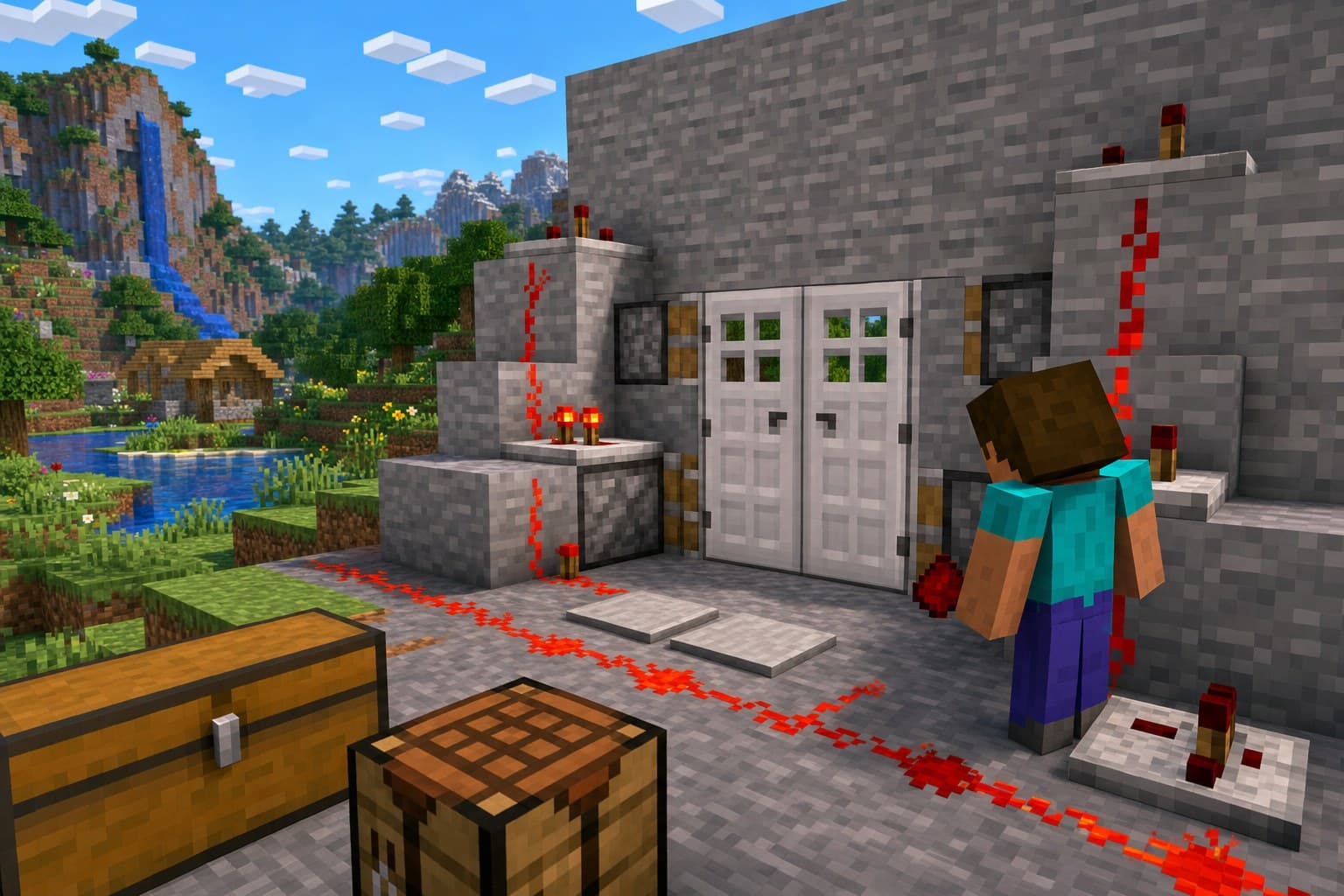
If you've already dipped your toes into redstone basics, building an automatic door is the perfect next project. It's satisfying, genuinely useful, and takes way less time than you'd think. Whether you want a door that swings open as you approach or a secret entrance hidden behind a wall, this guide will walk you through every step.
What You'll Need to Get Started
Gather these materials before you begin:
- 2 Doors: Wooden or iron both work great (iron doors can't be opened by hand, which makes them extra secure)
- 2 Pressure Plates: Stone or wooden, one for each side of the door
- Redstone Dust: A handful is plenty for a basic setup
- Building Blocks: Whatever matches your build for the doorframe
You don't need anything exotic here — this is one of the most beginner-friendly redstone projects you can tackle, and it's a great confidence builder if you're still getting comfortable with circuits.
Step 1: Build the Doorframe
- Create a 2-block-wide, 3-block-tall opening in your wall
- Place one door in each opening, side by side
- Right-click the bottom of each door to make sure they open outward the way you want
Take a second to check that both doors swing correctly before moving on — it's much easier to fix now than after the wiring is in.
Step 2: Place the Pressure Plates
- Place one pressure plate directly outside the door
- Place a second pressure plate directly inside the door
- This way, the door opens automatically whether you're arriving or leaving
Step 3: Wire It with Redstone
- Place redstone dust on the block underneath (or directly beside) each pressure plate
- Run the redstone dust to the block adjacent to the nearest door
- Repeat for both doors so each one has its own connection
Step on a pressure plate and watch your door swing open on its own. That first successful test never gets old!
Making It a Double Door
A single door looks a little narrow next to two-block-wide pressure plates. To make both doors open together:
- Connect both doors' redstone lines to the same pressure plate using a T-shaped or straight redstone path
- Make sure the redstone dust touches a block that's adjacent to both doors
- Test it — stepping on either plate should now open both doors at once
If the signal doesn't reach both doors, try adding a redstone torch beneath a block in the middle of the run to boost the signal, or just shorten the distance between the plate and the doors.
Building a Hidden Door
Once you're comfortable with the basics, hiding your door behind a solid wall adds a fun secret-base feel:
- Build your door and wiring as normal, but recess it one block into the wall
- Cover the door with a matching block on a sticky piston
- Wire the piston to the same pressure plate circuit as the door
- When triggered, the piston pulls the disguise block away just as the door opens
This takes a little more trial and error to line up perfectly, so don't worry if it takes a couple of tries — that's completely normal with piston builds.
Using Buttons Instead of Pressure Plates
Pressure plates are great for hands-free doors, but sometimes you want more control over exactly when a door opens — say, for a vault or a room you don't want mobs wandering into. Buttons are a simple swap:
- Replace each pressure plate with a button placed on a nearby wall or block
- Wire the redstone the same way you would for a pressure plate
- Now the door only opens when someone deliberately presses the button, not just by walking past
Stone buttons give a slightly longer "on" pulse than wooden ones, which can be handy if your door circuit needs a touch more time to fully open before the signal cuts.
Building a Keypad-Style Combination Door
Once you've got the basics down, try leveling up to a simple "combination lock" door using multiple buttons wired to different colored wool paths:
- Place 3-4 buttons in a row, each wired with a different colored wool underneath to keep the paths visually distinct
- Use redstone comparators to require a specific button (or specific order) to trigger the final door circuit
- Wrong buttons can be wired to do nothing, or even trigger a harmless "alarm" like a note block for fun
This is a more advanced project, so don't feel like you need to tackle it right away — it's a great goal to work toward once buttons and basic wiring feel natural.
Common Mistakes to Avoid
- Door opens the wrong way: Right-click the door before wiring it to flip which side it swings toward
- Redstone doesn't reach the door: Redstone dust weakens after 15 blocks — add a repeater if your circuit is long
- Only one door opens: Double-check that your redstone dust physically touches a block next to both doors, not just one
- Pressure plate triggers accidentally: Mobs can step on plates too — placing plates just inside a fence or wall keeps them exclusive to players
Troubleshooting Your Door Circuit
If your door isn't behaving quite right, work through these checks in order:
- Confirm the door swings the right way — right-click it before wiring, since rewiring around a door that opens the wrong direction wastes time
- Trace the redstone path block by block — a single missing or misplaced block anywhere in the line will break the whole circuit
- Check for redstone dust powering the wrong block — dust wants to connect to any adjacent redstone component, so keep unrelated circuits at least one block apart
- Test each pressure plate individually — stand on just one at a time to isolate which side of the circuit (if either) is misbehaving
Tips for Leveling Up Your Door Builds
- Use iron doors on exterior entrances since mobs can't open them by hand, only by pressure plate or button
- Try swapping pressure plates for buttons if you want more control over exactly when the door opens
- Combine this circuit with your redstone basics knowledge to add lighting that turns on with the same trigger
- Paint your redstone paths with different colored wool or terracotta underneath so you can visually trace circuits later without digging everything up
- If you're building a base with multiple automatic doors, keep a small notebook (in-game with signs, or just on paper) noting which lever or plate controls which door — it saves a lot of confusion later
Conclusion: Your Base Just Got an Upgrade
Nice work — you've officially built a fully automatic door, and honestly, that's one of the most satisfying redstone projects there is. From here, you're well-equipped to tackle bigger automation projects around your base, whether that's automatic farms, secret vault entrances, or full-on redstone-powered rooms. Keep experimenting, and don't be afraid to break things apart and rebuild — that's how every redstone builder gets better.